Your Reliable Partner for Industrial Belt Solutions
PTFE Conveyor Belt

PTFE Conveyor Belt

– Non-stick, low-friction PTFE conveyor belts for heat sealing, baking, laminating, food processing and other thermal processing applications

– Constructed with PTFE-coated fiberglass fabric, providing a continuous conveying surface with reliable release, heat resistance, chemical resistance and dimensional stability

– Available in different thicknesses, surface configurations and custom belt specifications to match conveyor equipment, operating temperatures and processing requirements

PTFE Conveyor Belt Construction

A PTFE conveyor belt typically combines a PTFE working surface with a woven reinforcement fabric, providing a stable conveying surface for industrial conveying and processing applications where heat resistance, non-stick release, low friction or chemical resistance are required. The PTFE layer provides non-stick performance, low friction and resistance to heat and many industrial chemicals, while the reinforcement fabric provides tensile strength, dimensional stability and support during continuous conveying.

Common PTFE conveyor belt construction options include:

PTFE Coating

The PTFE coating forms the belt’s working surface. PTFE provides low surface energy, non-stick performance, low friction, water and oil repellency, and strong resistance to heat and many chemicals.

Fiberglass Fabric Reinforcement

Woven fiberglass provides the structural reinforcement required for continuous conveying. It helps the belt maintain dimensional stability and shape under operating tension and elevated temperatures.

Solid and Closed-Surface Construction

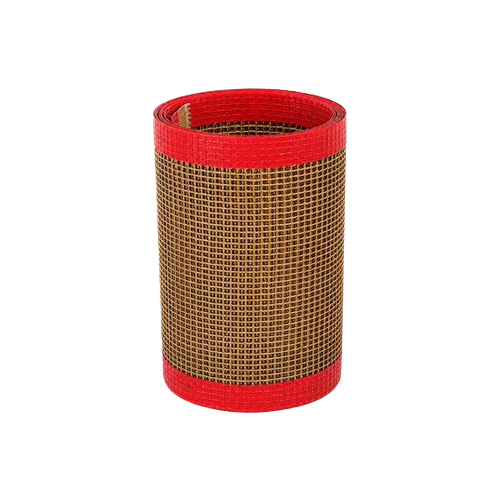
Solid and closed-surface PTFE belt constructions provide a continuous conveying surface for applications where consistent product support, smooth release, and low-friction conveying are required. Where airflow, heat transfer, or moisture passage is required, a PTFE mesh conveyor belt provides an open-mesh alternative.

Different Reinforcement Levels

PTFE belts can be selected in different fabric weights, thicknesses and reinforcement constructions according to belt load, speed, pulley diameter, flexing requirements and application conditions. Heavy-duty PTFE-coated fiberglass constructions are available for applications involving repeated thermal and mechanical loading.

PTFE Conveyor Belt Surface Options

TRANDVOX can supply PTFE conveyor belts with different surface configurations according to release, traction, heat and process-contact requirements.

Smooth PTFE Conveyor Belt

Smooth PTFE surfaces provide a consistent low-friction conveying surface and are suitable for applications requiring clean release and minimal material adhesion. They are commonly selected for heat sealing, food processing, product transfer and other processes where easy release is important.

Send Inquiry Now
Textured PTFE Conveyor Belt

Textured PTFE surfaces provide a controlled surface profile for applications where a completely smooth surface is not preferred. Different textures can be selected according to product contact, traction and process requirements.

Send Inquiry Now
Anti-Static PTFE Conveyor Belt

Anti-static PTFE belt constructions can be supplied for applications where static control is required. Anti-static performance should be specified separately because belt color or appearance alone does not determine electrical properties.

Send Inquiry Now

PTFE Conveyor Belt Fabrication Options

PTFE Conveyor Belt Specifications

PTFE conveyor belt specifications can be selected according to the conveyor design, operating temperature, belt speed, load, pulley diameter, product characteristics and required release performance.

Specification Available Options
Belt Material PTFE
Reinforcement Fiberglass Fabric / Specialty Reinforcement
Belt Construction Solid / Closed-Surface
Belt Surface Smooth / Textured / Anti-Static
Temperature Typically up to approximately 260°C; exact rating depends on construction
Belt Width Customized
Belt Length Customized
Belt Thickness Customized
Belt Color Brown / Black / White / Custom
Belt Joining Butt / Heat-Sealed Overlap / Other Custom Splices
Edge Reinforcement PTFE Film / PTFE Fabric / Reinforced Edge
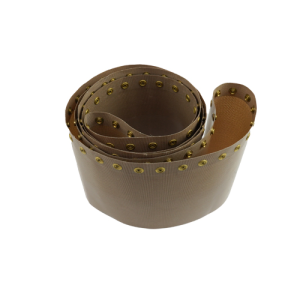
 Tracking & Guiding V Guides / Guide Cord / Guide Strip / Guide Snaps / Grommets / Other Options

Get Free Quote of PTFE Conveyor Belt

Looking for a PTFE conveyor belt for heat sealing, baking, laminating or industrial processing? Send us your belt dimensions, operating temperature, conveyor speed, pulley diameter, surface requirements and joining configuration for specification matching and quotation.

Custom PTFE Conveyor Belt Solutions

PTFE conveyor belts can be supplied in customized widths, lengths, thicknesses, surface constructions, splice configurations, edge reinforcements and guiding arrangements according to conveyor and application requirements.

TRANDVOX supports specification matching, customization coordination and sourcing based on belt drawings, dimensions, equipment information and operating conditions.

PTFE Conveyor Belt Applications

Solid PTFE conveyor belts are used in industrial processes where continuous product support, non-stick release, low friction, heat resistance or chemical resistance are important.

Food Processing and Baking

PTFE conveyor belts can be used for baking, cooking, heating, cooling and food transfer processes where a non-stick surface and heat resistance are required. Food-contact suitability depends on the exact belt materials and fabrication, so the specification and applicable compliance documentation should be confirmed for the intended application.

Typical applications include:

  • Bread and bun processing
  • Tortilla and flatbread production
  • Bakery products
  • Snack processing
  • Heated food conveying
  • Food release applications

Heat Sealing and Packaging

PTFE conveyor belts are widely used around continuous heat-sealing equipment because the PTFE surface helps prevent packaging films and heated materials from adhering to the belt. Closed-surface PTFE fabric belts are used in continuous band sealing systems for polyethylene and polypropylene packaging and other automated sealing processes.

Garment Fusing and Textile Processing

PTFE-coated conveyor belts can be used in garment fusing and heated textile processing where the belt must resist elevated temperatures while providing reliable material release.

Laminating and Composite Processing

PTFE-coated fiberglass belts and process fabrics can be used as release surfaces in laminating and composite manufacturing processes. The low-adhesion surface helps products separate from the belt following heating, pressing or curing operations.

Rubber and Polymer Processing

PTFE conveyor belts can be used in processes involving heated rubber, plastics and polymer-based materials where release performance and thermal resistance are required. PTFE-coated conveyor belts are also used in selected rubber profile extrusion and related processing applications.

Chemical and Process Applications

PTFE provides strong resistance to many industrial chemicals and solvents, making solid PTFE belts suitable for selected chemical, coating and process-contact applications where conventional belt materials may degrade more quickly. Application-specific chemical compatibility should always be confirmed before selection.

PTFE Conveyor Belt Selection

Selecting PTFE conveyor belting should start with the actual conveyor design, product characteristics and operating conditions rather than temperature alone. The belt construction, surface, thickness and joining method should be matched to the way the belt will be used.

1. Operating Temperature

Confirm both continuous and peak temperatures and select a belt construction suitable for the actual thermal conditions. The PTFE coating, reinforcement, splice and other fabricated components should all be appropriate for the intended operating temperature and thermal cycling.

2. Belt Construction and Flexibility

Belt thickness, fabric weight and reinforcement affect flexibility, tensile strength and dimensional stability. Thinner constructions can be suitable for conveyors with smaller pulley diameters, while heavier constructions may be preferred when greater mechanical support and durability are required.

3. Surface Contact and Release

Consider how the conveyed product interacts with the belt surface. Smooth PTFE surfaces are commonly selected when low friction and easy release are important, while textured surfaces may be considered when a controlled contact surface is required. Product adhesion, marking, surface sensitivity and operating conditions should all be evaluated when selecting the surface construction.

4. Load and Belt Speed

Match belt tensile strength and reinforcement to the conveying load, belt tension, operating speed and duty cycle. Continuous operation, frequent starts and stops, and repeated loading can place different demands on the belt construction.

5. Pulley Diameter and Conveyor Layout

Pulley diameter should be considered together with belt thickness, reinforcement and flexibility. Conveyor geometry, belt travel direction and the arrangement of drive and return components can also affect the suitable belt construction.

6. Joining and Tracking

The splice, edge reinforcement and tracking method should be considered as part of the complete belt configuration. The selected joining and guiding arrangement should be compatible with the belt construction, pulley dimensions and conveyor design to maintain stable operation and avoid unnecessary stress at the splice or belt edges.

FAQ

1. What is a PTFE conveyor belt?

A solid PTFE conveyor belt is an industrial conveyor belt with a PTFE working surface, commonly supported by a reinforced fabric substrate. It is designed for applications where low friction, non-stick release, heat resistance and chemical resistance are important.

2. What are PTFE conveyor belts used for?

PTFE conveyor belts are used in applications such as food processing, baking, heat sealing, packaging, garment fusing, laminating, composite processing, rubber and polymer processing, and selected high-temperature industrial conveying systems.

3. What temperature can a PTFE conveyor belt withstand?

PTFE conveyor belts can typically be supplied for continuous operating temperatures up to approximately 260°C in selected constructions. The actual temperature rating of a finished belt depends on its fabric, coating, thickness, splice, reinforcement and operating conditions, so the exact specification should always be confirmed for the intended application.

4. Are PTFE conveyor belts non-stick?

Yes. PTFE has very low surface energy and a low coefficient of friction, which provides strong non-stick and release characteristics. This makes PTFE-coated belts useful for applications involving sticky foods, polymer materials, heated films and other products that may adhere to conventional belts.

5. Are PTFE conveyor belts resistant to chemicals?

PTFE provides excellent chemical resistance and is chemically inert to many industrial chemicals. However, the complete belt construction, including reinforcement and fabrication components, should be evaluated for the specific chemical environment before selection.

6. Can PTFE conveyor belts be used for food processing?

Yes, specific PTFE belt constructions can be supplied for food-processing applications. However, food-contact suitability depends on the exact belt materials, coating, reinforcement, splice and fabrication. The applicable food-contact requirements and documentation should be confirmed for the complete belt specification rather than assumed from the PTFE material alone.

7. What is the difference between a solid PTFE conveyor belt and a PTFE mesh conveyor belt?

Solid or closed-surface PTFE conveyor belts provide a continuous conveying surface for applications requiring consistent product support and easy release. PTFE mesh conveyor belts use an open structure and are selected for processes where airflow or passage through the belt is required. The appropriate construction depends on the product and process requirements.

8. Does a black PTFE conveyor belt automatically provide anti-static performance?

No. Belt color does not by itself define electrical performance. Anti-static performance should be specified as a separate belt property and confirmed against the relevant technical data.

Send Inquiry Now
Contact Form

Related Products

Related Cases

Scroll to Top

Send Your Inquiry Now !

Contact Form